The Role of Personalization in Improving Website Navigation
Website navigation is the backbone of the user experience. By it, visitors can easily explore a site, find the information they need, and perform the desired action. When navigation is intuitive, users tend to engage more, remain longer, and progress smoothly toward conversions. But when the experience is confusing or cluttered, frustration builds leading to higher bounce rates and loss of opportunity. Navigation is very crucial not just from a user experience point of view but also in SEO, affecting search rankings and general discoverability.
In the past, static navigation was typically found on websites- one approach for every user. But today’s users want more. And this is where website personalization comes in. Based on user behavior, preferences, and interaction data, companies create dynamic navigation experiences that adapt in real time.
For businesses, personalization is not only an advantage but also a necessity to stay ahead of the competition. A recent survey conducted by Statista found that 95% of senior marketers think their personalization strategies are successful, showing how powerful personalization is in engaging users and growing businesses. This article will discuss integrating personalization to help enhance the user journey and reduce friction in directing better outcomes by establishing personalized website navigation.
1. Personalization in Improving Website Navigation
A rigid generic navigation structure imposed on users may frustrate rather than assist them. Visitors find it difficult to navigate through an unclear navigation structure when menus are cluttered, important content is buried, or labels are unclear. According to studies, 88% of users will not return to a site if they face unclear navigation. For companies, this means a loss of engagement, conversion, and an opportunity to build long-lasting relationships.
Personalized navigation modifies all this by adapting menus, links and content according to the behavior, preferences and intent of each visitor. It allows websites to dynamically tailor the experience to match the individual needs of the user, instead of presenting the same navigation options to every user. For example, on returning visits visitors may see recently viewed products or quick links to pages they frequently visit, which eliminates having to start the journey all over again. A first-time visitor will have a different experience, which might lead them into educational content or product discovery. Static to a user-centric navigation, this enables every interaction to appear relevant and intuitive.
More than just user convenience, personalized navigation becomes a professional concierge that cares for users’ needs and provides swift shortcuts to what is most important, creating immersive brand experiences that make every interaction memorable and relevant.
Thus, if the SaaS knows a visitor is looking at pricing, the navigation can bring forth relevant case studies or comparisons that might be made right then and there. When the e-commerce shopper does some browsing in the same category repeatedly, that particular category can be weighted heavily on their menu. These small but obvious changes reduce friction, increase engagement, and ultimately bring users closer to conversion.
Read: Why ISP Proxies are the Perfect Choice for Speed, Stability, and Security
2. Personalizing Navigation on Websites
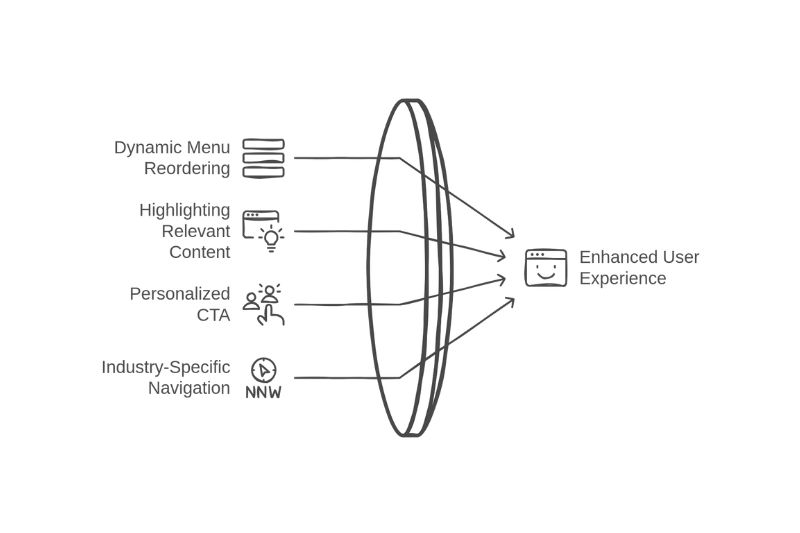
- Dynamic Menu Reordering:
Dynamic menu reordering is a very beneficial method whereby a navigation item would adjust according to a user’s past interactions. For example, if a visitor checks the pricing page of a SaaS platform on a regular basis, that option can be brought to the top of the menu so that friction is reduced and the speed of their decision-making is increased. Similarly, an e-commerce site can prioritize a shopper’s favorite categories for faster and more entertaining product discovery. This small but powerful change will ensure that users spend less time trying to find something and more in attending to those things they deeply care about.
- Highlighting Relevant Content:
A different method might involve underlining pertinent content in navigation on the website. By studying user preferences, websites may highlight certain sections, features, or articles that match specific interests. For example, a B2B SaaS may spotlight feature updates or case studies that pertain to a visitor’s industry or function. When users see content that speaks to their needs, they are more likely to be engaged, and thus the conversion pathway becomes clearer.
- Personalized CTA within Navigation:
Unlike the generic ones, businesses can customize CTAs to depend on a particular visitor’s stage in the journey. For instance, first-time visitors could be prompted to book a demo, while an existing customer would be prompted to check out advanced features or upgrade their current plan. This makes each interaction feel relevant, strengthening the strategic intent of the business in the mind of that user.
- Industry-Specific Navigation:
For B2B SaaS companies, personalization may extend to an industry-specific navigation that adapts based on the visitor’s type of business. Take, for instance, a salesperson using a CRM who might get navigation options that highlight lead management and pipeline tracking, while the head of marketing may see links to campaign analytics and automation tools. In other words, aligning navigation to a particular role will make for a much more intuitive and productive user experience in conducting the respective task.
3. Business Benefits of Smart Navigation
When executed well, personalized navigation produces actual business benefits through enhanced user experience and improved key performance indicators.
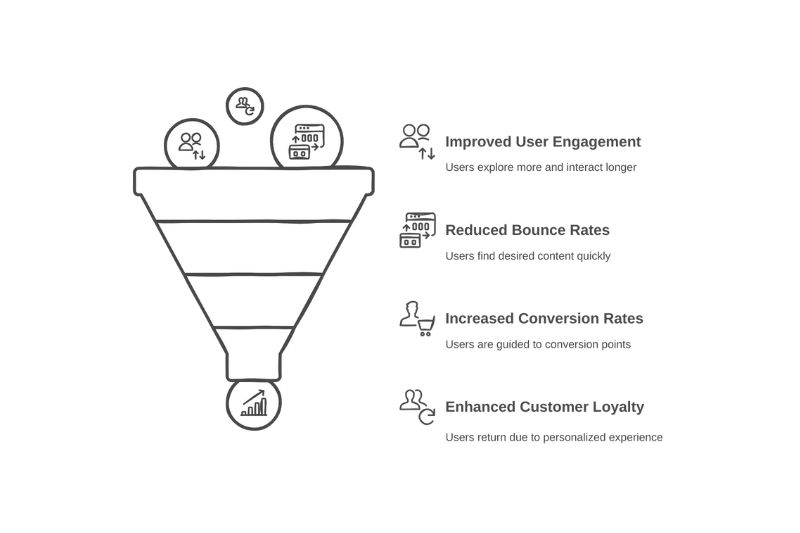
Key Advantages:
- Improved User Engagement:
The most immediate benefit, of course, is higher user engagement. When navigation comes across as more intuitive and personalized, users tend to explore multiple pages, stay longer on the site and pay more attention to related content. This leads to deeper user engagement, which creates opportunities for businesses to follow up leads and educate prospects while enhancing their brands.
- Reduced Bounce Rates:
Another area in which personalized navigation contributes importantly is in the reduction of bounce rates. Visitors are much less likely to exit their session due to frustration when they come to a website and find exactly what they want in minimal time. Businesses can greatly improve retention by displaying relevant content and making navigation simple enough to hold users for a while longer before losing them to competitors.
- Increased Conversion Rates:
One of the biggest impacts a business can see is higher conversion rates. Once users are more effectively guided into product pages, pricing information, or sign-up forms, the chances of conversion increase considerably. Samsung is a classic example of how this change brought about an impact when the company noticed sky-high drop-off rates on its category and product pages during the launch of the Galaxy Note 9. To solve this, the brand took the help of a web personalization platform, which personalized mobile web page layouts for visitors depending on the last-clicked category by each visitor. The results? A 10% conversion rate increase, purely based on navigation aligning with different users’ browsing behavior.
- Enhanced Customer Loyalty:
By enhancing user navigation further than just yielding short-term benefits, personalized navigation tends to create loyalty in the long run. A website behaves as a trustworthy entity that encourages the users to return and engage long-term, as it constantly adapts to the user’s preferences and gives an experience devoid of any friction in the engagement process. Users are more likely to make a return to the platform which appears familiar and is easy to navigate and keep responding to their needs. A report by McKinsey mentions that investments into website personalization increase revenue by 10-15%. This shows that personalized navigation is far beyond an enhancement for user experience; it is a growth strategy in and of itself.
4. Implementing Effectively: Overcoming Challenges
While personalized navigation allows for more engagement and minimizes bounce rates to drive conversions, implementing it effectively does present a series of challenges.
- Data Privacy Concerns:
Public awareness of data collection has increased the demand for transparency. With the implementation of laws such as GDPR and CCPA, it has become increasingly important to set up clear, consent-driven structures in order not to lose trust. To this end, organizations should balance the need for personalized services with the ethical use of data.
- Ensuring Relevance:
Personalization should not detract from the user experience; it should enhance it. When the bulk of recommendations becomes irrelevant, or when behavioral tracking becomes stale, the process can become detrimental to the user. The right segmentation based on browsing patterns and intent can ensure that customizations do their job, and thus need to be nurtured.
- Personalization vs. Usability Balance
Excessive customization often leads to inconsistency in the navigation system. Changes that come too often can confuse users. An intermediate state could be used to ensure some changes are made, while keeping navigation steady.
5. Implementation Best Practices
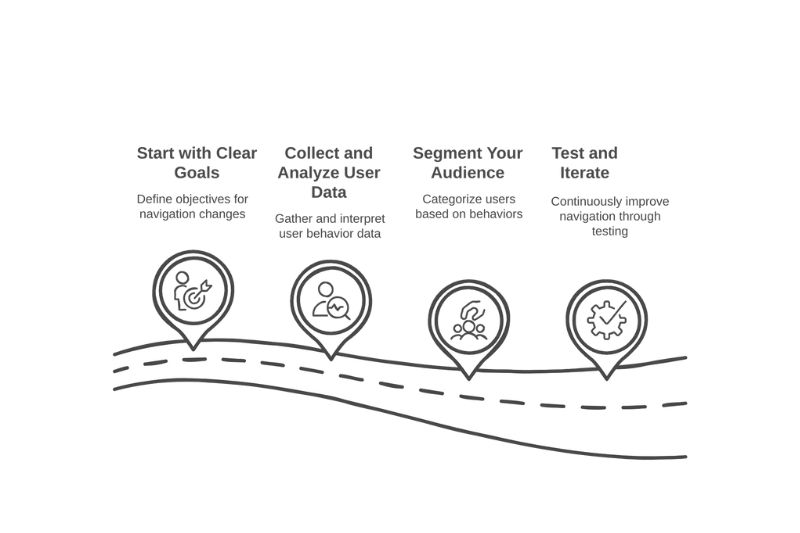
- Start with Clear Goals:
Before a business changes its website navigation, it needs to be clear what it aims to achieve: generating leads, improving product discovery, or reducing bounce rates. This will guide the process and help measure success through relevant key performance indicators (KPIs)—session duration, page views per visit, and conversions. Without a goal, personalization may be aimless and ineffective.
- Collect and Analyze User Data:
When the goals are set, the next step is to gather appropriate data that can drive personalization. Website analytics tools like Google Analytics help track site visitor navigation, drop-off points, and pages that attractthe most engagement. An understanding of those behaviors will help a business in deciding whether or not to make changes to its navigation elements. Web personalization AI tools can take this a step further by predicting user intent through past interactions so that personalization remains contextual and dynamic.
- Segment Your Audience:
Not all users will have the same needs; returning visitors may be looking for different information than first-time visitors, and a marketing professional using a SaaS platform will have different priorities than a sales executive. By segmenting users based on similar behaviors or demographics, businesses can create navigation experiences that feel intuitive and highly relevant. Segmentation makes sure that personalization improves usability; it won’t be just annoying for users with jarring changes.
- Test and Iterate:
Nothing is perfect, and personalization strategies are no exception to the need for continuous improvement. This entails various A/B testing for navigation structures, such as individualized CTAs and content recommendations, allowing a brand to assess its performance with its audience. Testing stops the guesswork and ensures that the personalization efforts are relevant at a later time. Regular iterations also allow the user experience to stay smooth and prevent personalization from becoming stale or borderline annoying.
Conclusion
Navigation for websites is in transition from static layouts to AI-driven adaptive experiences. AI and machine learning will detect needs in real-time and dynamically alter menus, highlight relevant sections, and suggest next steps based on a user’s browsing behavior and contextual cues.
Author’s Bio:
Vidhatanand is the Founder and CEO of Fragmatic, a web personalization platform for B2B businesses. He specializes in advancing AI-driven personalization and is passionate about creating technologies that help businesses deliver meaningful digital experiences.